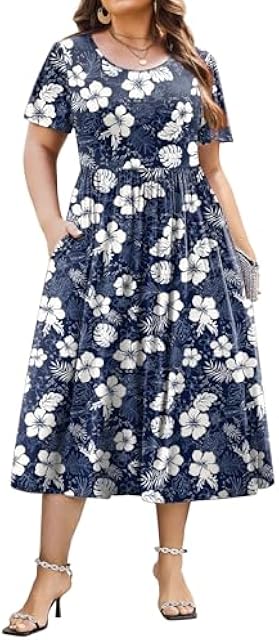
Modest wedding guest dresses usually cover the shoulders and upper arms, keep the neckline above the cleavage, and stay at or below the knee when you sit: typically a lined midi or maxi with elbow-length or longer sleeves. For a church wedding or other religious ceremony, ask the couple what the venue expects. Emily Post suggests checking whether head coverings are required and whether bare shoulders, bare arms or open-toed shoes would offend.
Modest wedding guest dresses give the coverage many women want, for religious requirements, cultural tradition, family expectations or simple preference, without looking like a compromise. The hard part is not finding a long dress with sleeves. It is knowing which standard you are dressing for, because a dress that is modest enough for a garden reception can fall short in a house of worship. This guide starts with that question, then gives a coverage checklist you can run against any listing, translates each dress code into a modest version, and covers sleeves in summer, head coverings, shoes and layering. The dresses below are there to shop once you know what you need.
Princess Christina, Mrs. Magnuson, and Tord Magnuson arriving as guests at the wedding of Princess Madeleine and Christopher O'Neill at the Royal Palace, Stockholm, 8 June 2013.Photo: Frankie Fouganthin on Wikimedia Commons · CC BY-SA 3.0
Shop the look
In stock now for modest wedding guest dresses
21% off
21% off today
DRESSTELLS Women's Cocktail Dresses, Formal Wedding Guest Modest Church Vintage Tea Party Midi Evening Dress
$31.44
Shop Now
Sleeve coverage
Women's Floral Boho Long Sleeve Maxi Dress V Neck Empire Waist Swing Flowy Wedding Guest Dress
Womens Fall Velvet Dress Short Sleeve V Neck Floral Maxi Dress Long Formal Winter Wedding Guest Dresses
$26.99
Shop Now
Women Floral Summer Sun Dress Flutter Sleeve Smocked Chiffon Midi Dress Casual Boho Flowy Dress with Pockets
$46.99
Shop Now
Plus sizes
Women Plus Size Short Sleeve Dress Loose Summer Casual A-Line Flowy Midi Dresses with Pockets
$25.99
Shop Now
Women's Short Sleeve V Neck Formal Wedding Guest Maxi Dresses Spring Fall Evening Party Long Dresses
$49.99
Shop Now
Sleeve coverage
Long Sleeve Fall Dresses for Women Square Neck A Line Flowy Casual Elegant Wedding Guest Party Maxi Dress
$49.99
Shop Now
Swipe to see more
Prices shown as of November 2, 2026.
Diagram
Coverage feature by venue: is it enough?
Elbow-length or longer sleeves, any venueYesCovers shoulders and upper arms, the most common baseline.
Midi or maxi hem, any venueYesStays below the knee when you sit.
Cap or flutter sleeves, house of worshipCheck firstCovers the shoulder, not the upper arm; ask, or carry a layer.
Sheer lace or mesh sleeves, house of worshipCheck firstSome count sheer as covered, others want opaque fabric; ask the couple.
Knee-length hem or a high slit, house of worshipCheck firstRides above the knee when seated; do the sit-down test.
Sleeveless dress with a jacket or shawl, house of worshipCheck firstWorks if the layer stays on for the whole ceremony.
Sleeveless midi, secular reception after the ceremonyYesUsually fine once you leave the house of worship; check with the couple if the family is conservative.
Strapless, spaghetti straps or an open back, house of worshipSkip itUnless fully covered by a layer for the ceremony.
Venue questions (head coverings; bare shoulders and arms; open-toed shoes): The Emily Post Institute, Wedding Guest Attire, read 22 October 2026. Verdicts are weddinggueststyle.com editorial guidance against the common baseline of covered shoulders and upper arms, no cleavage, and a hem at or below the knee; they are not the rules of any specific faith.
Modest is a standard, and someone else may set it
There is no single definition of a modest wedding guest dress. There are at least four situations, and each one has a different person setting the bar.
• A ceremony in a church or other house of worship. The venue and the couple's tradition decide. The Emily Post Institute describes a wedding as "a serious ceremony" that often takes place in a house of worship, and the first factor it lists after the invitation and the time of day is the nature of the service: secular or religious.
• A conservative family or region. Emily Post also lists local custom as a factor, noting that some parts of the country are more conservative than others. Here the bar is set by the families, even at a secular venue.
• A secular venue with no stated expectation. The dress code governs formality, and modesty is your own call.
• Personal preference. You set the standard. Many women dress modestly every day and need no other reason.
The practical difference is whether you need to ask. For the first two, you do. For the last two, the checklist further down is enough.
Ask three questions before you shop
Emily Post's wedding guest page turns the religious question into specifics. Does the religion or the culture of the couple require head coverings? Would bare shoulders and arms or open-toed shoes be offensive? Add one more that decides most outfits: how long should the hem be, and does that apply when seated?
Ask the couple, a family member or the wedding party, or look on the wedding website. Couples who expect modest dress usually say so, and they would rather answer a question than see a guest uncomfortable. If you cannot reach anyone, dress to the most conservative version you might meet: long or three-quarter sleeves, a crew, boat or high V-neckline, a lined midi or maxi, and a scarf in your bag.
This site does not list rules by denomination, because practice varies between communities, congregations and families, and a general list would be wrong for many of them. Ask the couple.
The question comes up constantly. In our analysis of 10,700 posts on r/Weddingattireapproval (16 April – 21 October 2026), 492 mentioned modesty, covering the arms or shoulders, or a church, cathedral, temple, mosque, synagogue or gurdwara. Most were not casual weddings: Cocktail or No Dress Code (128) and Formal (121) led, followed by Semi Formal/Dressy Casual (64) and Black/White Tie (58). Of the 492, 397 mentioned a church and 84 mentioned a Catholic ceremony.
Diagram
Coverage and house-of-worship posts by dress-code flair
Cocktail or No Dress Code128posts
Formal121posts
Semi Formal/Dressy Casual64posts
Black/White Tie58posts
Special Dress Code23posts
Is this too white?21posts
All other flairs77posts
weddinggueststyle.com analysis of 10,700 r/Weddingattireapproval posts, 16 April – 21 October 2026, read 22 October 2026. Posts whose title or text matched the regex \bmodest|cover(?:ing)? (?:up )?(?:my |the |your )?(?:arms|shoulders)|\bchurch\b|\bcathedral\b|\btemple\b|\bmosque\b|\bsynagogue\b|\bgurdwara\b (case-insensitive), grouped by flair; 492 posts in total; aggregate counts only.
The coverage checklist
Most dresses that fail a modest standard fail somewhere the main product photo does not show. Run every listing through these six checks.
• Sleeves. Note the length in the description, not just the photo: cap, short, elbow, three-quarter or full. Cap and flutter sleeves cover the shoulder but not the upper arm.
• Neckline. Crew, boat, square and high V-necks keep coverage. Look at a side-view photo to judge the depth of a V, and remember that wrap dresses can gape when you lean; a fixed crossover, a snap at the neckline or a camisole underneath keeps it closed.
• The back. Many dresses with a high front have a low, keyhole or open back. Look for a back-view photo and search the description for "open back", "keyhole" or "V-back".
• Hem when seated. A hem that sits at the knee standing rises when you sit. If at-or-below-the-knee matters, choose a midi rather than a knee-length dress.
• The slit. A side or front slit that looks modest standing can open well above the knee when you walk or sit. Check where the listing says the slit starts, or choose no slit.
• Sheer layers. Unlined chiffon and lace can become see-through in sunlight or under a camera flash. Look for "fully lined" in the description, or a medium-weight crepe.
Modest by dress code
Coverage and formality work together: more fabric in a good material looks richer, not plainer. The Emily Post Institute's attire guide gives the women's garments for each code, and each has a modest version.
At formal codes, choose long sleeves in lace or crepe on a lined gown, or a velvet or satin maxi with a boat neck. At semi-formal and cocktail, a midi with three-quarter sleeves in crepe or a beaded fabric reads dressy. At daytime and casual weddings, simpler fabrics are fine: cotton, linen or a floral print with elbow sleeves.
Modest does not mean shapeless. A defined waist, a structured bodice and a deliberate neckline make a covered dress look chosen rather than settled for. When the invitation names no code, Emily Post's rule still applies: the invitation and the time of the wedding are your best guide to formality. An evening ceremony in a cathedral calls for a long, sleeved gown or a dressy midi; a morning ceremony followed by a lunch reception calls for a day dress with sleeves.
Each dress code has its own guide on this site with the full lists for women and men.
Diagram
The modest version of each dress code
Emily Post's list for women
Modest version
Watch for
White tie
Floor-length evening gown; long gloves optional
Long-sleeve or three-quarter-sleeve gown in satin, crepe or lined lace
Strapless gowns that rely on gloves for coverage
Black tie
Floor-length gown, dressy cocktail dress or dressiest little black dress
Floor-length gown with sleeves, or a long-sleeve dressy cocktail dress below the knee
High leg slits on evening gowns
Black tie optional
The black tie list plus dressy separates
A maxi skirt with a long-sleeve dressy top, or a sleeved gown
Sheer sleeves that are unlined
Semi-formal / cocktail
Short afternoon or cocktail dress, little black dress, long dressy skirt and top, dressy separates
Midi with elbow or three-quarter sleeves; long skirt with a dressy blouse
Knee-length hems that ride up when seated
Dressy casual
A dress, skirt and dressy top, or a dressy pants outfit
Printed midi with sleeves; wide-leg pants with a covered blouse
Wrap necklines that gape
Casual
Sundress, long or short skirt, khakis or nice jeans
Cotton or linen maxi with elbow sleeves; a long skirt and tee
Thin, unlined cotton in full sun
Women's lists: The Emily Post Institute, Attire Guide: Dress Codes from Casual to White Tie, read 22 October 2026 (Emily Post files cocktail under semi-formal). Modest versions are weddinggueststyle.com editorial guidance, 22 October 2026.
Sleeves that cover without overheating
Sleeves are the hardest part of modest dressing in summer. Lightweight chiffon, cotton voile and thin crepe in long-sleeve cuts give coverage with some airflow, and loose bishop and bell sleeves let more air in than fitted ones. Three-quarter and elbow-length sleeves meet many standards and are noticeably cooler than full sleeves.
Fabric weight matters more than sleeve length for comfort. A loose, lined chiffon maxi with long sleeves can be cooler than a fitted, sleeveless scuba dress. Natural and semi-natural fibers such as cotton, linen and viscose breathe better than heavy polyester.
Lace and mesh sleeves are a middle ground, and whether sheer counts as covered is a genuine venue and personal decision. Some women and some venues count sheer lace with a modest neckline and hem as covered; others want fully opaque fabric. When in doubt, choose lined sleeves or carry an opaque layer.
Head coverings and shoes
Emily Post's guest attire table carries a footnote on the women's attire: hats or head coverings are optional, unless required. Whether they are required is a question for the couple, not a general rule. If the answer is yes, ask what kind is expected, since a hat, a lace veil and a scarf are not interchangeable everywhere.
If you cannot find out, a lightweight scarf in a color that coordinates with the dress takes up little room in a bag and can also cover the shoulders.
Shoes are on the same list of questions: Emily Post asks whether open-toed shoes would be offensive. If the answer might be yes, closed-toe pumps, low block heels or dressy flats are the safe choice, and they work just as well at the reception.
When the ceremony and reception are in different places, plan the outfit for the stricter of the two and adjust on the way. A shawl that comes off, a scarf that goes into a bag or a switch from closed-toe pumps to sandals lets one dress cover both, as long as the couple's family does not expect the same standard at the reception. If they do, keep the ceremony version on all day.
Layering a dress you already love
If you love a dress that falls short of the standard you need, layering can bridge the gap.
• A bolero, cropped jacket or dressy cardigan covers the shoulders and arms.
• A fitted long-sleeve top or a lace layer worn underneath turns a sleeveless or strapless dress into a covered one.
• A shawl or pashmina covers the shoulders for the ceremony and comes off for the reception, if the reception is somewhere the standard relaxes.
• A slip or lining fixes a dress that is sheer in daylight.
Choose layers in the same color as the dress, or a deliberate contrast, so the outfit looks planned rather than patched. A layer that slides off during the ceremony does not count as coverage, so try sitting, standing and raising your arms in it at home.
Shop faster with the right filters
General wedding guest grids are not built for coverage. Many mix strapless, halter and one-shoulder dresses in with sleeved ones, so filter before you scroll.
• Filter by sleeve length first, then by length (midi or maxi). This removes most dresses that fail.
• Search the description for "lined" or "fully lined", and skip listings that do not say.
• Look for a back-view photo and a seated photo, or check customer photos.
• Compare the stated length against your height. A maxi that hits the floor on a tall model can be a midi on someone shorter, and a midi on a petite figure becomes a maxi.
• Check the return window, since coverage is easiest to judge in person.
Mother-of-the-bride and church-dress sections, modest-first labels that build sleeves and higher necklines into the original pattern, and mainstream ranges with sleeve filters are all good places to look alongside the dresses on this page.
Frequently Asked Questions
Quick answers to help you find the perfect wedding guest dress.
Not always. Many modest standards ask for covered shoulders and upper arms, which three-quarter and elbow-length sleeves meet. Some venues and families expect sleeves to the wrist, so ask the couple if you are unsure.
It depends on the tradition and the venue. Emily Post lists head coverings as optional unless required, and puts the question among the first things to settle before choosing an outfit. If you cannot find out, a coordinating scarf takes up little room in a bag.
For some standards, yes; for others, no. Lace sleeves over bare arms cover the shape of the arm but not the skin. If the venue or family expects covered arms, choose opaque or lined sleeves, or carry a layer.
Yes, as long as the layer stays on for the part of the day that needs coverage, usually the ceremony. Choose a cardigan, bolero or jacket that suits the formality of the dress, not a casual knit.
Modest-first labels, mother-of-the-bride and church-dress sections, and mainstream retailers that let you filter by sleeve length and dress length. Check the back view, the lining and the slit before ordering. The dresses on this page are a starting point.
Sources
The Emily Post Institute — Wedding Guest Attire: What to Wear · read 22 October 2026 · 'The wedding invitation and the time of the wedding will be your best guide to its formality'; wedding as a serious ceremony often in a house of worship; questions on secular vs religious service, head coverings, bare shoulders and arms, open-toed shoes; local custom (some parts of the country more conservative); 'Hats or head coverings optional (unless required)'.
 21% off