Floral wedding guest dresses work at casual, garden, cocktail and semi-formal weddings, and at formal ones when the print is large or dark-ground and the fabric is crepe, satin or chiffon at midi or maxi length. Match the ground color to the season: light grounds for spring and summer, navy, black or burgundy grounds for fall and winter. Avoid prints on a white or ivory ground, which can read as bridal.
Floral wedding guest dresses are among the easiest ways to look dressed for a wedding without wearing a single solid color, and among the easiest to get slightly wrong. Whether a floral reads as wedding attire or as a picnic dress comes down to three things: the color of the ground behind the flowers, the scale of the print, and the fabric it is printed on. This page goes through each, then covers styling and the one floral that causes real trouble.
Look past the blooms to the background. The ground color decides both the formality and the season of a floral dress.
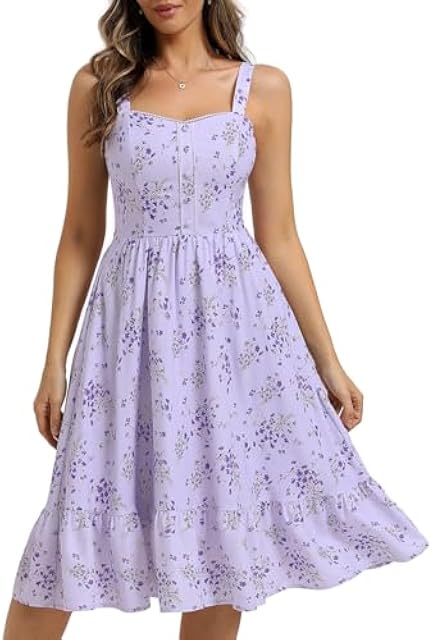
Dark grounds, such as navy, black, burgundy or forest green with bright or jewel-toned flowers, read as the most formal. They belong at fall and winter weddings and at evening receptions, and a dark-ground floral in satin or heavy crepe at midi or maxi length can hold its own at a formal wedding. Mid-tone grounds, such as dusty blue, sage or rose, are the most adaptable across seasons. Light grounds with soft pastel flowers read as spring and summer daytime: garden parties, vineyard ceremonies, brunch receptions.
The ground is also where the one real floral risk lives: a print on a white, ivory or cream ground. The white test further down deals with it.
Floral wedding guest dresses under each dress code
Emily Post's attire guide never mentions prints, so the rule for florals comes from reading its garment lists and asking whether a floral version of that garment still belongs. Usually it does; what changes from code to code is how much print, on which fabric, at what length.
Casual. The casual list includes a sundress, so a cotton or voile floral, a ditsy print and a knee or midi length are all correct. This is the one code where a small, busy print on a light ground is the right answer rather than a risk.
Dressy casual. The list runs up to nice jeans with a dressy top, which tells you how relaxed the floor is. A floral midi in crepe, georgette or a polished cotton fits easily; a wrap dress with a medium print is the classic choice.
Semi-formal and cocktail. Emily Post files cocktail dresses under semi-formal and lists a short afternoon or cocktail dress, a little black dress, a long skirt and top, or dressy separates, with the advice to err formal after 6 p.m. Here the floral needs a dressier fabric: chiffon, crepe or a satin-finish print, at midi length, with the print medium or large rather than tiny.
Formal and black tie optional. A floor-length or long midi floral in lined chiffon, satin or heavy crepe, ideally on a dark ground. Embroidered or jacquard florals, where the pattern is in the weave or the thread, read more formal than a printed one.
Black tie. The list is a floor-length evening gown, a dressy cocktail dress or your dressiest little black dress. A floral gown can meet the first item, but only a dark-ground or large-scale print in an evening fabric; a daytime print in a gown shape still reads as daytime. People ask about this often enough that 50 of the floral posts in our sample were filed under the black and white tie flair. If you are unsure, a solid gown is the safe move. At white tie, wear a solid.
Our guides to what to wear to a casual wedding, what is cocktail attire and black tie attire set out each code in full.
Run the white test before you buy
Pale grounds are where floral dresses go wrong, and the numbers show how often guests worry about it. In our analysis of 10,700 posts on r/Weddingattireapproval (16 April – 21 October 2026), 617 posts mention a floral or florals. 207 of them, about a third, also mention white, ivory or cream, and 77 were filed under the subreddit's "Is this too white?" flair, nearly as many as under its barn, beach and garden flair (86).
The test takes a minute. Look at the product photo from arm's length, or turn it to grayscale on your phone, and ask what color the dress is. If the honest answer is white, cream or ivory with some flowers on it, it will read that way across a room and in a flash photograph, where small pale flowers drop out first. If the answer is green, blue, pink or navy, the ground is safe.
A few patterns pass even with white in the print. White flowers on a dark or saturated ground are fine, because the ground carries the color. A print where pale and colored areas are roughly balanced is usually fine in person but worth checking in photos. What fails is a white or ivory ground with sparse, small or pastel flowers, especially in a lace-trimmed or bridal-looking cut.
If the dress fails, choose another. Accessories in a strong color do not change what the dress reads as from the back of the ceremony.
Diagram
Where 617 floral posts were filed
Cocktail or no dress code124posts
Formal97posts
Semi-formal or dressy casual87posts
Barn, beach or garden86posts
Is this too white?77posts
Black or white tie50posts
Casual16posts
Posts whose title or text matches the regex (?i)\bflorals?\b, counted by the post's flair; smaller flairs omitted. "Black tie" and "white tie" were masked before any color count. Source: weddinggueststyle.com analysis of 10,700 r/Weddingattireapproval posts, 16 April – 21 October 2026 (Arctic Shift archive). Read 22 October 2026.
Print scale, fabric and cut set the formality
Scale works the opposite way to what many people expect. Large, painterly flowers read as more formal than tiny ones, because the eye sees the shape of the dress first and the pattern second. Small, busy ditsy prints read as relaxed and suit casual and daytime weddings. Medium-scale prints are the most versatile and photograph clearly; very tiny prints can blur into texture in photos.
Scale also interacts with your frame. Very large prints can overwhelm a petite figure, so look for medium prints with some space between motifs. Taller figures carry big, dramatic blooms on a maxi well. On curvier figures, a medium print with clearly defined motifs on a dark ground tends to look more polished than a very small, busy print, and prints with a vertical or diagonal flow lengthen the line.
Fabric moves the same print up or down the formality scale. Chiffon and georgette suit garden and semi-formal weddings; crepe gives structure and works from cocktail upward; satin and velvet florals belong to fall, winter and formal evenings. Cotton and linen florals belong at casual and outdoor daytime weddings only.
For the cut, an A-line shows a print across the skirt without the distortion that ruching or bodycon stretch causes. A defined waist matters on a floral maxi: a shapeless column in a floral print can look like a housedress, while an empire waist, wrap bodice or fitted-then-flared shape does not.
Pull one color from the print for accessories
The simplest way to accessorize a floral dress is to pick one color from the print and repeat it once, in the shoes or the clutch. If the flowers are blush, sage and cream on navy, blush shoes with a neutral bag, or nude accessories that echo the cream, will tie the outfit together.
Metallics work with almost any floral palette. A gold, silver or rose gold clutch and simple metallic earrings add polish without competing with the pattern. What does not work is a new color unrelated to the print, such as a bright red bag with a blue-and-green floral, or a second pattern in the shoes or bag. Keep everything else solid and let the dress carry the pattern.
Prints that suit each time of year
Spring: soft pinks, lavenders and greens on light or mid-tone grounds, watercolor and garden-rose prints, midi lengths in chiffon or cotton blends.
Summer: bolder palettes and larger prints, including tropical and botanical designs, in lightweight fabrics; a print maxi in chiffon is cool to wear and looks finished with simple sandals.
Fall: burgundy, rust, gold and cream blooms on dark grounds, in crepe or satin.
Winter: deep reds and jewel tones on midnight or black grounds, velvet or heavy crepe, or black with metallic embroidered botanicals. A bright spring floral on a light ground looks out of season at a December wedding.
What to check in a floral listing
Floral dresses look more different in person than solids do, so read the listing closely.
Print scale. Compare the flowers with the model's hand or face in the photo; listings rarely state motif size, and a print that looks medium on a tall model reads large on a petite frame.
Placement. An engineered print, placed to fit the pattern pieces, looks more expensive than an allover print cut at random, where seams slice through flowers at the bust and side. Zoom in on the side seams and the waist.
Ground color in the customer photos. Studio light warms or cools a print, so a "blush" ground can arrive closer to ivory. Customer photos taken in daylight show the real ground better than the main image.
Lining. Chiffon and georgette florals should say lined or fully lined, particularly on a light ground, for the same see-through reason as any pale outdoor dress.
Fabric content. Printed polyester chiffon and crepe are the norm and are fine; a cotton floral belongs to casual and daytime codes, and a satin or velvet floral to evening and cold-weather ones.
Quick answers to help you find the perfect wedding guest dress.
Not if the print and fabric are formal. A large or dark-ground floral in satin, heavy crepe or lined chiffon at midi or maxi length works at a formal wedding. What reads too casual is a small, bright print on cotton. At strict black tie, a solid gown is the safer choice.
Yes. Arrangements are three-dimensional and your dress is a flat pattern, so they read as different things and will not clash. Choose a palette that suits the season rather than trying to match the flowers.
Solid shoes, in a color pulled from the print or a neutral such as nude, black or metallic. Strappy sandals suit casual and garden weddings, and heeled pumps suit more formal ones. Avoid patterned shoes, which compete with the dress.
Only if the color, not the white, dominates. A dress with a white or ivory ground and small or pastel flowers reads as white from a distance and in photos, so skip it. White flowers on a navy, black or saturated ground are fine. If you have to ask, run the grayscale test above, and if the dress still reads pale, choose another.
Yes, when the print and fabric move up with the hour. Choose a dark ground such as navy, black, burgundy or forest green, a medium or large print, and a dressier fabric such as satin, crepe or lined chiffon at midi or full length. Emily Post's advice to err formal after 6 p.m. applies to prints as much as to cut.
At a glance
What the floral wedding guest dresses on this page cost today.
Pieces tracked on this page
24
Price range
$15 – $60
Median price
$41
Under $50
21 of 24
Discounted right now
12 (avg 29% off, deepest 63%)
With sleeve coverage
8 of 24
Listed in plus sizing
1 of 24
Prices change often — check the current price before you buy.
Sources
The Emily Post Institute — Attire Guide: Dress Codes from Casual to White Tie · read 22 October 2026 · Garment lists per code: casual sundress; dressy casual up to nice jeans and a dressy top; semi-formal short afternoon or cocktail dress, LBD, long skirt and top or dressy separates, err formal after 6 p.m.; black tie floor-length gown, dressy cocktail dress or dressiest LBD.



 1
 2
 3
 4
 5
 6
 17% off
 17% off

 37% off


 62% off


 6% off
 12% off

 15% off