November wedding guest dresses are where the seasonal-dressing habit finally stops being useful, and I want to make that argument properly rather than hand you another list of jewel tones. For most of the year, the season and the venue point in roughly the same direction. A June wedding is warm and probably at least partly outside, so a light fabric serves both the weather and the room. A November wedding breaks that alignment completely. The weather outside is cold, often wet, sometimes genuinely miserable — and you will experience approximately eleven minutes of it, walking from a car to a door and from a door to a car. The other five hours happen inside a heated building with a hundred and fifty other people in it, under lighting the couple paid a great deal of money to get right. If you dress for November the month, you will spend the reception quietly overheating in boiled wool while everyone dances. If you dress for the November building, you will be comfortable, you will photograph well, and you will solve the cold with a coat instead of with the dress. That is the entire thesis, and the rest of this page is what follows from it.
Our picks for november wedding guest dresses
Our favourites right now, in order.
1
Sleeve coverage
ZESICA Women's Long Sleeve Floral Bodycon Dress 2026 Spring Fall Ruched Mesh Wedding Guest Cocktail Party Maxi Dresses, Dusty Blue, L
Mid-range for this page at $43.99. It's full length, with genuine sleeve coverage rather than a cap or cold-shoulder.
$43.996% offShop Now
2
Sleeve coverage
ZESICA Women's Long Sleeve Floral Bodycon Dress 2026 Spring Fall Ruched Mesh Wedding Guest Cocktail Party Maxi Dresses, Tie Dye Brown, S
Sits in the middle of the pack at $49.99. It's full length, with genuine sleeve coverage rather than a cap or cold-shoulder.
Mid-range for this page at $57.99. It's full length in satin, so it catches venue lighting — worth checking what you wear under it.
$57.99Shop Now
6
Verdusa Women's Wedding Guest Dress Halter Flowy Chiffon Asymmetrical Long Summer Prom Dress Black Large
Sits in the middle of the pack at $46.99. It's chiffon, light enough to layer without adding bulk.
$46.99Shop Now
More November Wedding Guest Dresses
Verdusa Women's Wedding Guest Dress Halter Flowy Chiffon Asymmetrical Long Summer Prom Dress Brown Medium
$49.99
Shop Now
Sleeve coverage
Verdusa Women's Fall Wedding Guest Dress Floral Mesh Maxi Dresses Elegant Formal Long Sleeve Cocktail Black Small
$48.99
Shop Now
oten Women's Chiffon Dress Flutter Sleeve A-Line Formal Gown Cocktail Wedding Guest Evening Party Dresses Navy Blue Large
$49.99
Shop Now
6% off
Sleeve coverage
ZESICA Women's Long Sleeve Floral Bodycon Dress 2026 Spring Fall Ruched Mesh Wedding Guest Cocktail Party Maxi Dresses, Dusty Blue, S
$43.99
Shop Now
15% off
Sleeve coverage
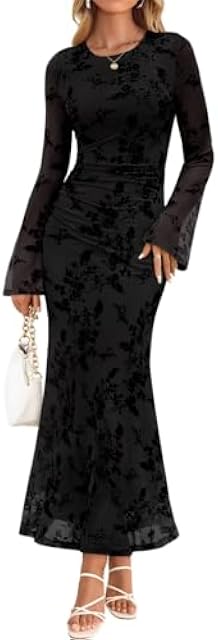
ZESICA Women's Long Sleeve Floral Bodycon Dress 2026 Spring Fall Ruched Mesh Wedding Guest Cocktail Party Maxi Dresses, Black, M
$49.99
Shop Now
Sleeve coverage
Verdusa Women's Floral Wedding Guest Dress Long Sleeve Mesh Slimming Cocktail Vacation Maxi Dresses Black Khaki
$48.99
Shop Now
18% off
Sleeve coverage
Simplee Women's Floral Boho Long Sleeve Maxi Dress V Neck Empire Waist Swing Flowy Wedding Guest Dress Navy Floral XL
$40.99
Shop Now
16% off
Sleeve coverage
ZESICA Womens Fall Long Sleeve Wedding Guest Midi Dresses Black M
$45.99
Shop Now
Sleeve coverage
BTFBM Women's Maxi Dresses Spring 2026 Long Sleeve Ruched Bodycon Solid Ruffle Mermaid Cocktail Wedding Guest Dress(Black,Large)
$49.99
Shop Now
Sleeve coverage
Women's Ruched Bodycon Long Sleeve Wedding Guest Maxi Dress,M,Black
$39.99
Shop Now
Sleeve coverage
BORIFLORS Women's Bodycon Fall Wedding Guest Long Sleeve Maxi Dress,M,Black
$39.99
Shop Now
Sleeve coverage
Verdusa Women's Fall Wedding Guest Dress Floral Mesh Maxi Dresses Elegant Formal Long Sleeve Cocktail Black Large
$48.99
Shop Now
Cold-weather fabric
Flessibili Women's Sleeveless Velvet Maxi Dress High Slit Formal Wedding Guest Cocktail Dress A#Coffee Medium
$54.99
Shop Now
10% off
Cold-weather fabric
GRACE KARIN 2026 Velvet Wedding Cocktail Maxi Dresses for Women Wine Red L
$35.97
Shop Now
Sleeve coverage
Vakkest Women Off The Shoulder Formal Dresses Long Sleeve Evening Party Velvet Maxi Dress High Split Cocktail Gowns Black
$47.99
Shop Now
Cold-weather fabric
MEROKEETY Women's V Neck Wrap Velvet Maxi Wedding Guest Dress Bell Sleeve Split Bridesmaid Cocktail Party Formal Dresses, Burgundy, M
$49.99
Shop Now
Prices shown as of September 18, 2026.
At a glance
What the november wedding guest dresses on this page cost today.
Pieces tracked on this page
24
Price range
$36 – $70
Median price
$49
Under $50
19 of 24
Discounted right now
7 (avg 11% off, deepest 18%)
With sleeve coverage
14 of 24
Prices change often — check the current price before you buy.
Why November Is the Month the Seasonal Rulebook Stops Working
The seasonal approach to wedding guest dressing is a useful shortcut most of the year because it encodes something real. In spring and summer, weddings move outdoors, ceremonies happen in daylight, and a lighter fabric genuinely serves you better. In October the shortcut still half works, because October weddings really are frequently outdoors and the temperature swing between a late-afternoon ceremony and a nighttime exit is something your dress has to survive. October is a garment problem.
November is not. By November, outdoor ceremonies have essentially disappeared outside a narrow band of the Sun Belt. Couples who wanted a lawn ceremony had one in September. Couples marrying in November have chosen — deliberately, often for exactly this reason — a hotel ballroom, a restored warehouse, a historic library, a church followed by a country club, a restaurant buyout, a museum atrium, a barn with real heating. The season has been designed out of the event. And once the season is designed out of the event, dressing for the season is dressing for something that is not happening.
What this changes in practice is which variables matter. Under the seasonal model, the questions are: how cold will it be, will I need sleeves, is this fabric warm enough. Under the venue model, the questions are entirely different. How is this room lit, and will my colour hold under it? How warm does this room run once it is full — because a ballroom at capacity with a working kitchen behind it is frequently seventy-five degrees regardless of what the thermometer says outside? What is the floor made of, and will a thin sole hurt after three hours on marble? Is there a coat check, or am I responsible for a wool coat all night? How formal is this building, independent of how formal the invitation sounded?
That last one deserves its own paragraph, because it is where most November mistakes originate. November weddings tend to be more formal than the invitation implies, and the reason is architectural rather than social. A couple who chose a ballroom, a hotel, or a landmark building chose a room with visual weight — chandeliers, high ceilings, heavy drapery, marble, dark wood. Rooms like that set a floor on formality that no wording on a save-the-date can lower. I have watched guests turn up to a November wedding in a perfectly nice printed cotton midi because the invitation said 'festive', walk into a room with twenty-foot ceilings and gold sconces, and spend the entire cocktail hour aware of it. The invitation was not lying. The building simply outvoted it.
So the practical instruction is: before you look at a single dress, look at the venue. Find its website. Look at the photographs of the actual room where the reception will be. Not the exterior, not the garden they use in summer — the room. Almost every question you have about what to wear is answered there, and answered more reliably than by the month on the calendar. Is it warm-lit and gold-toned, or cool and white? Is it a dark room where a black dress will vanish, or a bright one where it will read as an anchor? Is the floor wood, carpet, or stone? Are the ceilings high enough that a long dress will look proportionate, or is it a low-ceilinged restaurant space where a floor-length gown will look like it wandered in from a different party?
There is a second reason the seasonal shortcut misleads people in November specifically, and it is about daylight. A November wedding that starts at four in the afternoon is already effectively an evening wedding, because it is dark by five. That collapses the daytime-versus-evening distinction the whole dress-code vocabulary rests on. A four o'clock summer wedding is a daytime event and calls for daytime dressing; a four o'clock November wedding is not, and dressing it as one is the second most common November error after underestimating the venue. If the ceremony ends after sunset, dress for evening — deeper colours, more sheen, real jewellery, a heavier shoe — regardless of what the printed start time implies. The invitation says four. The room will say eight.
Once you have both of those, the season becomes what it should be: a hint about colour, a nudge toward evening dressing, and a reminder to bring a coat. Not a constraint on the dress.
What Dressing for the Room Actually Means: Fabric, Colour and Weight
If the building is the client, the choices follow fairly directly, and they are not the choices a seasonal list would give you.
Start with fabric weight, because this is where the seasonal instinct does the most damage. The impulse in November is to reach for the heaviest thing you own — thick boiled wool, dense ponte, a lined tweed sheath, heavy crushed velvet. In a heated ballroom that has been full for two hours, all of those are a mistake. Heat in a packed room does not distribute evenly; it collects at head height on a dance floor, and a dress with no breathability becomes uncomfortable in a way that shows in photographs. What you want is a fabric that reads warm and behaves cool. Mid-weight crepe is the single best answer here and it is why you see so much of it on well-dressed guests at winter weddings: it has opacity, it has enough body to hold a clean line, it does not cling, it does not wrinkle across the lap during dinner, and it breathes far better than any knit of comparable visual weight. Structured satin, particularly the heavier matte satins rather than the shiny liquid ones, does the same job with more evening presence. Stretch velvet sits in the middle — genuinely appropriate to the season, genuinely warm, and best in a midi or a sleeveless silhouette rather than a full-length long-sleeve, which is often too much inside a warm building.
What I would actively steer away from: unlined chiffon, which reads summer under any lighting and offers nothing; heavy chunky knit, which reads casual no matter how nice the dress is; and anything sequinned from neckline to hem, which is a December and New Year's fabric more than a November one and tends to overpower a room that is not already lit for it.
Colour is the other place the venue outranks the calendar, and the mechanism is lighting. Most November receptions are lit warm — incandescent-toned uplighting, candles on the tables, string bulbs, gold-shaded sconces. Warm light shifts every colour a step toward orange and desaturates everything cool. This is why the classic winter palette exists and why it works: emerald, sapphire, garnet, deep plum, bronze and chocolate all hold their character under warm light, and several of them actively improve. It is also why cool pastels — powder blue, mint, lilac, icy grey — so often look slightly off in November wedding photographs. They are not wrong for the season in any moral sense. They simply go muddy in the room.
Black deserves a direct answer because people still ask. Black is entirely appropriate at a November wedding and has been for years. The only real consideration is contrast: in a dark, moody, candlelit room, an unadorned matte black dress can disappear into the background of every group photograph. If the room is dark, choose black with a texture, a sheen, a beaded detail or a strong silhouette so it holds shape against the wall. In a bright ballroom, plain black is one of the most elegant things you can wear.
Then there is proportion, which is the most overlooked venue variable of all. A high-ceilinged historic room supports length and drama — a full-length column, a fluid gown, a longer sleeve. A low-ceilinged restaurant or loft space does not; a midi with a defined waist will look considered where a gown looks costume. Look at the ceiling height in the venue photographs and let it set your hemline. It sounds fussy. It is the difference between a dress that looks like it belongs in the room and one that looks like it was chosen from a catalogue.
Finally, weight in the literal sense: shoes. November weddings are long, indoor, seated-then-standing events on hard floors, and they run late because there is no sunset to structure the evening around. A block heel, a low heel, or a genuinely well-made flat will serve you better than a stiletto on marble at eleven o'clock. Nobody photographs your heel height. Everyone notices whether you danced.
One last note on finish, because it separates a good November dress from a merely adequate one. Indoor evening light is unforgiving about surface. Matte fabrics absorb it and can go flat in photographs taken across a dim room; high-shine liquid satin reflects it and can blow out under a flash. The fabrics that photograph best in a warm-lit reception are the ones with a broken or textured surface — matte satin, brushed velvet, crepe with a subtle slub, jacquard, a lace overlay, small tonal beading. They catch enough light to give the dress dimension without turning into a mirror. If you are choosing between two dresses you like equally, choose the one with more surface interest. It will look better in every photograph taken after six o'clock, which in November is most of them.
The Coat Is the Seasonal Garment, and Other Consequences
The logical consequence of dressing for the building is that the season has to go somewhere. It goes into the coat. This is the single most useful reframe I can offer for November, and it is genuinely liberating once you accept it: your coat is your winter wear, your dress is your indoor wear, and they have completely different jobs.
This means you can stop trying to find a dress that is simultaneously warm enough for a parking lot and cool enough for a dance floor. That dress does not exist, and the pursuit of it is why so many November guests end up in something heavier than they wanted. Instead, buy or borrow one good coat that goes over formal clothing, and let the dress be exactly as light as the room requires. A wool wrap coat in camel, black, charcoal or a deep colour will cover almost any dress in this category. The critical fit detail is that it has to clear the dress: a coat that stops at mid-thigh over a full-length gown looks wrong in every photograph taken between the car and the door, and a narrow-sleeved coat will not go over a full or structured sleeve without crushing it. Try them on together. It takes five minutes and it is the check nobody performs.
The other consequences of the venue-first approach are smaller but they compound. Hosiery becomes optional rather than obligatory, because you are indoors — wear it if you like the finish, skip it if you do not, but do not wear it purely because it is November. Sleeves become an aesthetic choice rather than a thermal one, which is freeing: a sleeveless column with beautiful shoulders is completely appropriate to a November wedding in a warm ballroom, and a long sleeve is appropriate because it looks good, not because it is cold. A shoulder covering in the form of a fine wrap or stole is still worth carrying, but for a different reason than the weather — heated rooms have cold edges, and the seat furthest from the dance floor is often the seat nearest a door.
Bag choice changes too. If there is no coat check, you are carrying a coat, a bag and a drink, and a clutch with no strap becomes a genuine problem around the second hour. A small shoulder bag or a clutch with a removable chain solves it and costs you nothing in formality.
And then there is the exception that proves the whole argument, which is worth naming honestly: the Thanksgiving-weekend wedding. A meaningful share of November weddings cluster around that weekend, and they behave slightly differently. They are more likely to involve out-of-town family, more likely to run across multiple events, and more likely to include a genuinely casual component — a welcome drinks night, a morning-after brunch. For those satellite events, the venue-first logic still applies; you are simply reading a different building. A brewery welcome party and a country club brunch are not the same dress code, and neither is governed by the fact that it is November.
It is worth saying what this approach does not mean, because the argument can be pushed too far. Dressing for the building is not an excuse to wear something that ignores the season entirely. A bright citrus-yellow sundress in a warm-lit November ballroom will be technically comfortable and visually wrong, because the guests around you, the flowers, the table linens and the lighting design will all be operating in a deeper register and you will read as out of key. The season still governs the palette and the general mood. What it no longer governs is fabric weight, sleeve length, hosiery and hemline — the practical variables people mistakenly treat as weather decisions when they are really room decisions.
There is also a small category of genuine exceptions worth flagging. Destination November weddings in warm climates, a handful of southern outdoor ceremonies, and the increasingly common heated-tent reception all reintroduce real outdoor exposure. In those cases you are back to October-style thinking: adaptable fabric, coverable shoulders, a hem that clears damp ground, and a shoe that does not sink. The test is simple and it is the same test throughout — will I be outside for more than about ten minutes? If yes, the garment has to handle it. If no, the coat does.
The underlying discipline is the same throughout. Find out where you will actually be standing. Look at that room. Dress for it. Bring a coat. Everything people write about November wedding guest dresses that is not downstream of those four steps is decoration, and most of it is a list of jewel tones you already knew about.
Frequently Asked Questions
Quick answers to help you find the perfect wedding guest dress.
Let the ceiling decide. High-ceilinged ballrooms, historic buildings and hotels support full-length and it will look proportionate. Restaurants, lofts and low-ceilinged private rooms are better served by a midi with a defined waist. Both are correct for November; the room tells you which.
Yes, without hesitation. The only real question is contrast. In a dark candlelit room, plain matte black can disappear in group photographs, so choose black with texture, sheen, beading or a strong silhouette. In a bright ballroom, plain black is about as elegant as it gets.
It is right, with a caveat about coverage. Stretch velvet in a midi or a sleeveless column is ideal. A full-length long-sleeve velvet gown is often too warm once a heated room fills up. Choose velvet for one or two of length, sleeve and weight — not all three.
No. Sleeves in November are an aesthetic decision, not a thermal one, because you will be indoors. A sleeveless dress with a good coat over it and a fine wrap in your bag is completely appropriate and often more comfortable than a long sleeve in a full ballroom.
Emerald, sapphire, garnet, deep plum, bronze and chocolate all hold their character under warm incandescent and candlelight. Cool pastels — powder blue, mint, lilac, icy grey — tend to go muddy. It is a lighting effect, not a rule about the season.
Warmer than people plan for. A ballroom at capacity, with a working kitchen behind it and a full dance floor, frequently runs in the mid-seventies regardless of the outdoor temperature. This is the main argument for choosing a mid-weight fabric over the heaviest thing in your wardrobe.
A wool wrap or straight-cut coat in camel, black, charcoal or a deep tone. Two fit checks matter: it must be long enough to clear the hem of your dress, and the sleeve must be wide enough to go over your dress sleeve without crushing it. Try them on together before the day.
Optional. Since you are indoors, wear them if you like the finished look or the leg colour they give you, and skip them if you do not. Sheer black or a fine nude both work. Opaque tights read more daytime and pair better with a midi than with anything formal.
Something you can stand on a hard floor in for four hours. Block heels, low heels and well-constructed flats all beat a stiletto on marble at eleven at night. November receptions run long because there is no sunset to shape the evening, so comfort has more time to matter.
Mostly in the surrounding events. The wedding itself follows the same venue-first logic, but Thanksgiving-weekend weddings often add a welcome drinks night and a morning-after brunch. Read each of those buildings separately — a brewery and a country club are not the same dress code.
Yes, if it is a dark-ground floral with large-scale, painterly flowers in deep tones. Light-background prints and small ditsy florals read spring under any lighting. Scale and background colour do all the work here, not the presence of flowers.
More formal than the wording suggests. Couples marrying in November have almost always chosen an architecturally weighty indoor venue, and that room sets a floor on formality no invitation can lower. When in doubt, look at the venue's photographs of the actual reception room and match its register.


 1
1 2
2 3
3 4
4 5
5 6
6

 15% off
 18% off
 16% off


 10% off
